|
|




.jpg)
 |  |  |  |
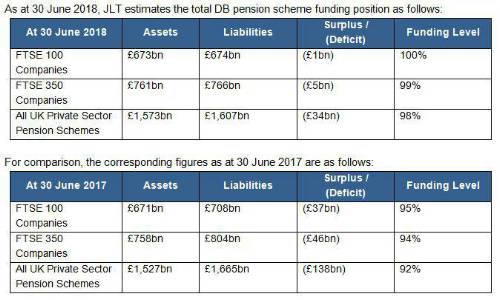
JLT Employee Benefits (JLT) has updated its monthly index, showing the funding position of all UK private sector defined benefit (DB) pension schemes under the standard accounting measure (IAS19) used in company reports and accounts. |
Murray Wright, Deputy Chief Actuary, JLT Employee Benefits, comments: “Half year results are strong for pension schemes when compared to the position twelve months ago and also against 31 December 2017. Rises in corporate bond yields, alongside solid equity market returns have contributed to lower reported deficits. “FTSE 100 companies are very close to showing an aggregate surplus for the first time in a decade. This milestone highlights the striking point that these schemes are now in a position where they need to earn a return of less than 3% p.a. on their assets over the long run to allow them to pay benefits as they fall due to members. A return of less than 3% p.a. over the long run would generally be regarded as an achievable target for most schemes, even those running a low risk investment strategy.
“Pension schemes that are ahead of schedule on their funding plans should actively seek to minimise their reliance on the sponsor through an integrated funding and investment strategy linked to expected scheme cash flows and at the same time de-risk their liabilities. A bull market that is almost 10 years old can’t be relied upon to keep delivering results.” |
|
|
|
| Capital Actuary | ||
| London - £110,000 Per Annum | ||
| Qualified Pricing Actuary, Casualty | ||
| Bermuda - Negotiable | ||
| Head of Short and Long Tail Pricing | ||
| London - £180,000 Per Annum | ||
| Reserving Actuary | ||
| London - £120,000 Per Annum | ||
| Qualified Pricing Actuary, Casualty | ||
| Bermuda - Negotiable | ||
| Reserving Actuary | ||
| London - £120,000 Per Annum | ||
| Qualified Pricing Actuary, Property | ||
| London - £140,000 Per Annum | ||
| Specialty Pricing Actuary (Part time ... | ||
| London - £125,000 Per Annum | ||
| Pricing Actuary | ||
| London - £180,000 Per Annum | ||
| Actuary - Financial Planning & Analysis | ||
| London/Hybrid - Negotiable | ||
| Capital Actuary | ||
| London/Hybrid - £100,000 Per Annum | ||
| Reserving Actuary | ||
| London - £120,000 Per Annum | ||
| Pricing Actuary, Marine Cargo/Property | ||
| London - £130,000 to £150,000 Per Annum | ||
| Pricing Actuary – Cyber | ||
| London - £120,000 Per Annum | ||
| Reinsurance Pricing Actuary, Analytics | ||
| London - £130,000 to £180,000 Per Annum | ||
| Reinsurance Pricing Actuary | ||
| London - £140,000 Per Annum | ||
| Head of Capital | ||
| London - £170,000 Per Annum | ||
| ART Pricing | ||
| London - £100,000 Per Annum | ||
| Pricing Transformation Actuary | ||
| London - £130,000 Per Annum | ||
| Pricing Actuary | ||
| London - £80,000 to £120,000 Per Annum | ||




Be the first to contribute to our definitive actuarial reference forum. Built by actuaries for actuaries.
Copyright © 2026 Actuarial Post. Created by Zero-One Design Ltd



(2).jpg)